You can't out-work your nervous system
Why the leaders I work with get more done by protecting their recovery time
Since running a retreat in Somerset with Matthew Cooke this summer, I've been building more nervous system literacy into my work with leaders, one-to-one and in teams.
Nervous system literacy means understanding how our bodies respond to pressure, and using that knowledge to work, lead and live better. There's a lot to it. But one lesson keeps coming up, and I think it's becoming one of the most important things we can understand about how we work:
We can't focus all day. Our attention works in cycles, and it needs recovery to do its best work.
Most of us are being asked to think harder and faster, for longer, with fewer natural pauses. The instinct is to push through. Our biology says that doesn't actually work.
That's because we don't have just one type of attention. We have two distinct kinds, and once we understand what they are, we can work with both our capabilities and our constraints.
Two kinds of attention
Directed attention is the effortful, focused kind. Reading this, working through a spreadsheet, building a proposal, holding your own in a hard meeting.
Undirected attention is the opposite. Walking, showering, staring out of the window, cleaning, letting the mind wander.
We can only hold directed attention for so long, roughly 90 to 120 minutes, before it starts to fray. The fix isn't more effort. It's a stretch of undirected attention to recover. Even 15 minutes helps, and 30 is better. On a normal day, most of us have three to five of these focused stretches in us. No more.
The window of tolerance
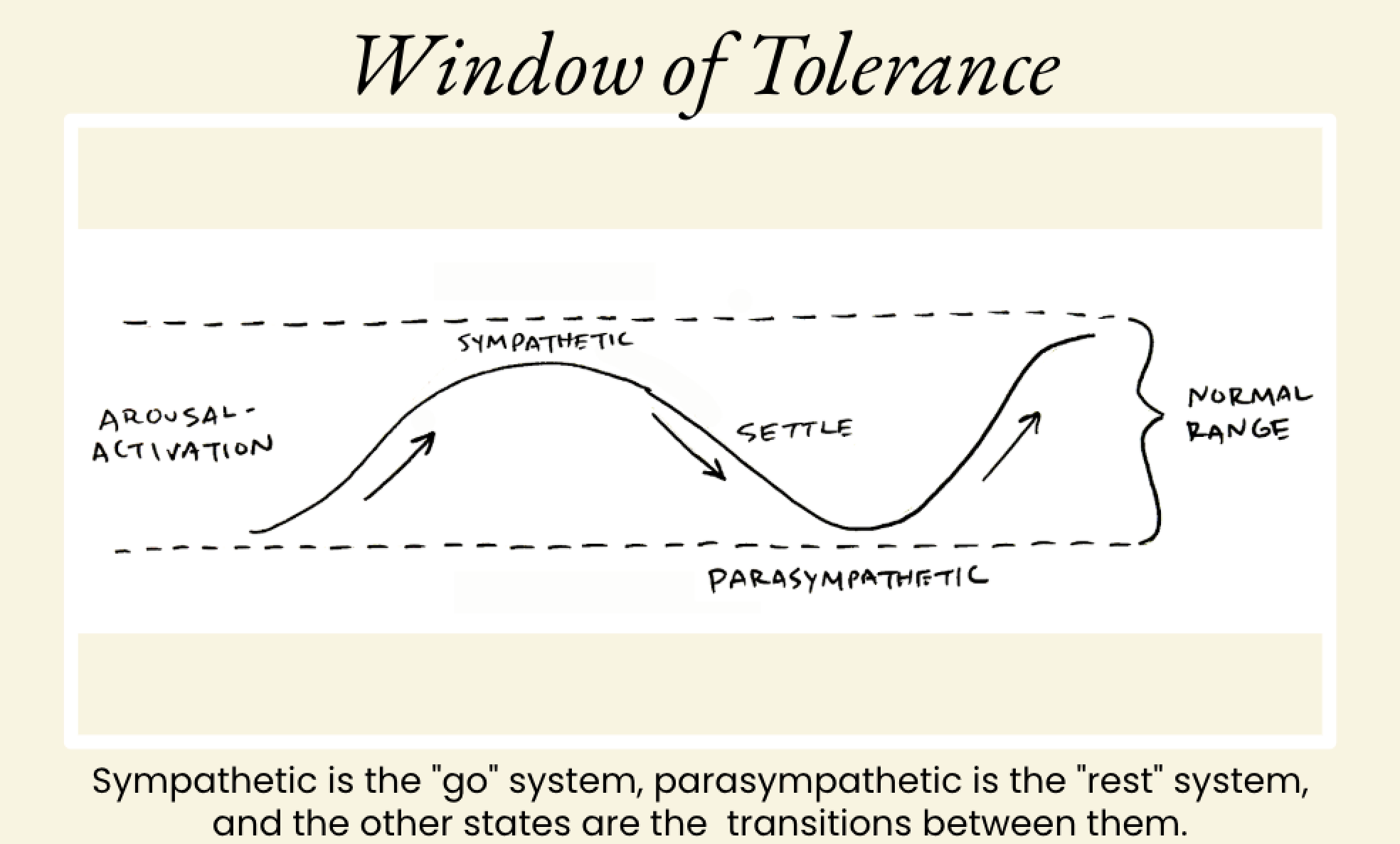
The diagram below shows what's often called the window of tolerance. This is the healthy range between switched on and settled, and it's where we do our best thinking. Focused work draws on the "go" system. Recovery lets us settle back down before we go again. That rhythm keeps us inside the window.
Push through without recovery and we drift out of it, into overwhelm at one end or shutdown at the other. That's when decisions get worse, patience runs out and small things feel big.
What this looks like in practice
Plan your day around three to five focused blocks, not eight hours of output.
Build recovery into your diary between those blocks. Don't schedule over it.
Make the recovery genuinely undirected: a walk, not your inbox.
Stop treating the gaps between meetings as spare capacity.
If you lead a team, the same applies. You'll get more from people by protecting their gaps than by filling them.
We aren't computers or machines. We're animals, and we come with the constraints of animals. Performing better isn't about knuckling down and doing more. It's about working with your biology instead of against it.
This is where I'm spending a lot of my time with leaders and teams. I work on it in a few ways:
One-to-one coaching
Workshops, from a few hours to a full day
A virtual or in-person teaching and coaching series for teams
If you'd like to explore how this might work for you and your team, I'm happy to talk. (Just drop me a line at sarah@thorpe-scott.com.)