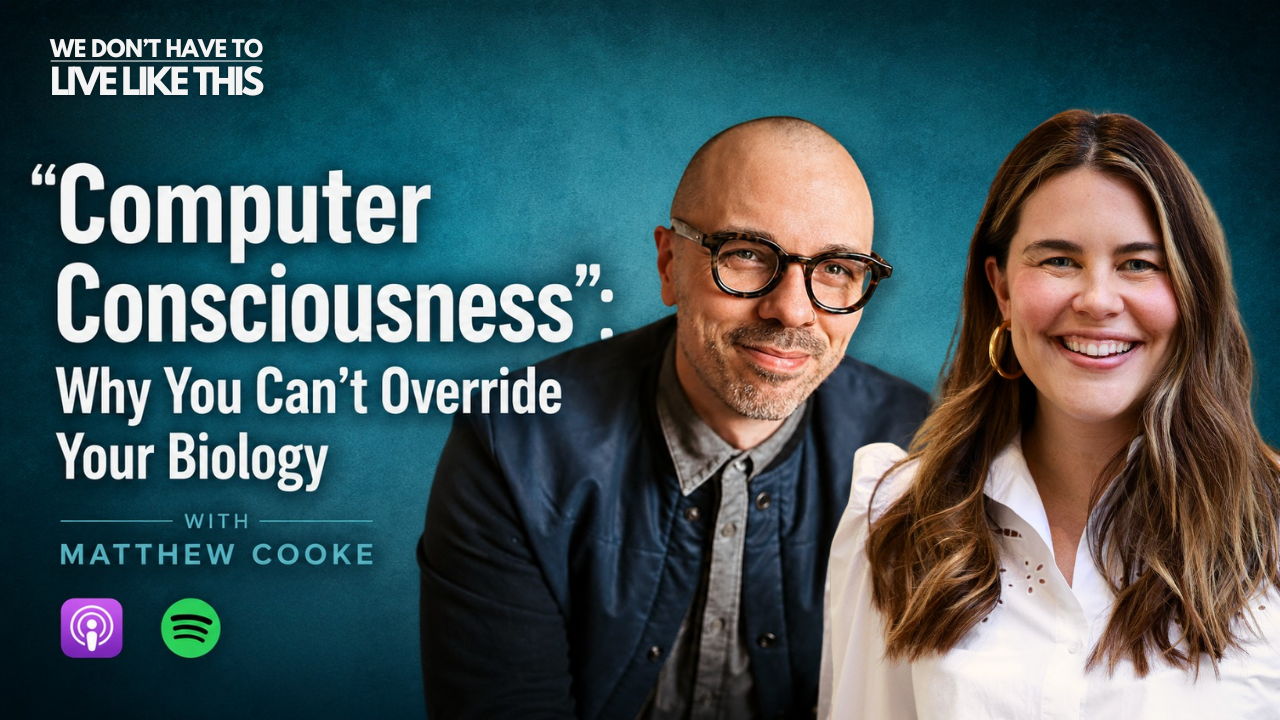
Episode 1: Why You can’t Override Your Biology, with Matthew Cooke
Transcript
Sarah: [00:00:00] I'm so excited to welcome Matthew Cooke here today to We Don't Have to Live Like This. He is the founder of Body-Based Breakthrough, a leading somatic coaching certification program that bridges neuroscience, movement and mindfulness to help practitioners and organizations unlock nervous system literacy.
His work integrates trauma-informed principles with practical science-backed tools to help people move from burnout and reactivity into regulation, clarity, and inspired action. Thank you so much for being here, Matthew, and welcome to the show.
Matthew: Oh, thanks Sarah. I'm so happy to be here.
Sarah: Today I am really excited and I know you're excited as well to talk about connection and disconnection from the body, as it relates to our nervous systems. You're gonna teach us so many things. I'm so excited to learn, but really again, it's about that connection and disconnection from the body.
Why it's happening, why it [00:01:00] even matters, especially to everyone out there who wants to lead, work and live better. Before we get into all of that, I wanna ask you as this tradition on this show, what was your We Don't Have to Live Like This moment that led you into this work.
Matthew: Well this is actually it. Backstory, basically coming outta university, I worked for a tech company and we were building essentially the Netflix for Optimal Living was the idea. And I was head of content curation and so I got to speak to 200 plus of the world's thought leaders in everything from neuroscience to productivity to conscious business, conscious parenting, mindfulness and spirituality, health.
It was amazing, Sarah. And I was so passionate about it, just like everybody in a tech startup, where we were working 70 plus hour work weeks. And so unfortunately at 24 years old, I kept getting these like dizzy, [00:02:00] flu-like symptoms. But this is the best part, Sarah — it was always on Fridays. I don't know why.
It was Friday afternoon. I would get really dizzy and like these flu-like symptoms and it would happen like every other week. And I would get really sick over the weekend and then Sunday afternoon would pop up and I would be ready to go for the next week. That happened for about six months and then I just fully burnt out, just so completely.
I remember there was one day I turned over just to try to grab my phone on the nightstand. And my girlfriend at the time who eventually became my wife, she — I could barely turn over to get my phone and I thought she'd be like, oh sweetie. Let me help you. And she was just pissed, Sarah.
She was so angry with me 'cause she's like, I'm so sick of this. You are not home 'cause you're always working and when you are home, you're always sick.
Sarah: Hmm.
Matthew: So I don't feel like I'm ever getting you at all in our relationship. And I remember seeing her [00:03:00] storm out of the apartment — at the time I was living in San Diego — and we had one of those metal screen doors and it slammed so hard.
And I remember feeling the rattling happening in my body as she slammed it and walked out, terrified that she wouldn't come back. And that felt like rock bottom. 'Cause I remember then I pulled open my Chase app. Here in the States we have Chase banking and I had $4 and 32 cents in my account because I was spending so much — I'm sorry — on trying to, oh, let me get you flowers. Let me take you to dinner. And so it was like, I was trying to keep up with all of the working that I was doing and all of that to try to make up for the lack of connection that we had in our relationship. But really it was 'cause I was so disconnected from myself. And so that was like, okay, I'm burnt out. I need to figure this out. I felt like my body and my mind were at war with one another. I was trying to fix my body. It was like, [00:04:00] body, why aren't you doing what I want you to do?
Sarah: How did you know you were burnt out?
Matthew: Well, a couple things. I mean, the dizziness — which a lot of people get, it's like a vertigo type symptom. I've since realized was actually a trauma response. But at the time it was this, I need to run. It was like my mind was running a hundred miles per hour faster than my body was. And so my mind was trying to agilely zip around, but my body was like, wait, I didn't finish the last thing that we just did. And so I wasn't going at the speed of life, I was just trying to keep up with some perceived speed that I thought everyone else needed me to be at.
And when you're in tech environments and the kind of clients and folks that you and I support, there is like this embedded urgency.
And many times it's very real because [00:05:00] there's dollars connected to that, there's runway that we have. And so there's this speed that everything needs to be done with.
And that needs to be balanced because that creates a nervous system that is constantly in flight, fight, freeze, which I'm sure most people have heard that term. It's this sense of I'm always on — survival energy — and the system can only handle that for so long before it just completely crashes.
Sarah: Thanks for sharing all of that, and thanks for sharing your story earlier. That sounds incredibly difficult, and it's kind of wild to think about that happening at 24 when you're young and have so much energy and so much genuine excitement about what you're doing.
Matthew: Oh my gosh. Yeah. No, that was the problem. I was so jazzed about it. And we had all these phrases like, uh, Thank God it's Monday. I was — Sarah, at the time I was like practically like snorting Adderall because it was [00:06:00] like I needed so much energy to maintain that high level of output. Like just to maintain that and my 24-year-old body, like you said, should have so much vitality in it to be able to handle that, but my body just couldn't take it anymore. So yeah, eventually it just was like I fell off a cliff. And a lot of people I think nowadays are experiencing that sooner and sooner and sooner.
We have an epidemic of it in many ways.
Sarah: I often think about, and bear with me on this metaphor — increasingly, I'm beginning to think a lot about how our bodies are essentially like outdated hardware for the modern world, where it's like the bodies and brains that we have are more or less the same bodies that people had when they were building the pyramids, stone by stone, or
Matthew: Very much so.
Sarah: Saxon tribes here in the UK living in huts however many thousand plus years ago.
And those same bodies are now being asked [00:07:00] to handle modernity. And you know, we're both sitting in rooms that are electrified right now. We can work till all hours because of the electric lights, which no one talks about that because that seems really almost old school now. The fact that we have digital devices — and you and I are communicating through screens right now, which is amazing that we can do that — but also we can get burnt out by being on screens. You just — all the things that we, you know, I think there's a lot of dialogue that more people are starting to become aware of. And even just the constant connectivity of phones, also just noise. Like how many of us live in urban environments or even not totally urban environments where there's modern sounds of construction and we just don't have silence.
We're not amongst the trees and the water, which can sound kind of woo woo sometimes, but our bodies are actually meant to be in those spaces. There's a reason that water and trees and green space regulate us. With all of that, and I know you'll have way more [00:08:00] expertise to share on that, but that's how I think about it.
And I'm curious, like, are we just in a catch 22, like a double bind where our bodies aren't meant for this world and also the modern day workplace that is demanding and that does require so much of us? What do you think about that?
Matthew: Yeah. I call it computer consciousness. It's like this idea that because our computers are plugged in and their battery can run 24/7 at the highest level of performance — and we surround ourselves with that instead of trees, like you said — we have started to sort of gaslight ourselves into believing that, oh yeah, I should be perfectly running at a hundred percent octane all of the time as well, rather than recognizing that the human body has a biological rhythm.
There are ups and downs, there is a pulse to life and the way that our systems are meant to operate. And so, yeah, [00:09:00] I think that that in many ways is what we want to return back to on some level. And I also — I'm not a Luddite. We all have technology and I think it's just a matter of how am I utilizing that in concert with my biology?
And one of the things that we talk about with Body-Based Breakthrough is this idea that the 1900s taught us to read and write. The 2000s taught us to code and connect with social media. And the 2030s are really about teaching us how to regulate.
Sarah: Mm.
Matthew: So for B3, we are — our main focus is bringing literacy of the nervous system to the workplace.
Because I think we've reached a certain threshold where, like you said, we just can't keep up and people are crashing left and right.
Sarah: I think you're totally right and I also — I am starting to see this even [00:10:00] more, in a more pronounced way amongst people I coach, friends, colleagues, myself, around even just a disconnection from ourselves and a disconnection from joy. Because we've become so much more productive than ever before and we're doing all the things and accomplishing all the things, but we don't feel connected with other people in the same way.
But what you just said — if it's the 2030s where we're supposed to be taught or learn as a society about regulation, what do we need to know about the nervous system? Like, and really even as simple as: what are the different states in the nervous system?
How do we know that we're in those states, and how do we move between them? What do we need to know just to get started?
Matthew: Gorgeous. Oh my gosh, I love that. So there's a gentleman named Dan Siegel, Dr. Dan Siegel, who coined a term called The Window of Tolerance in the early 1990s, end of the 1980s. And it's [00:11:00] this idea that when people talk about like, I have capacity to do that, or I don't have the capacity to do that right now — what they're really speaking to is this window. Another name for it is Window of Presence, which is like I can handle the bigness of life coming at me. So our nervous system moves in these waves of activation, arousal, intensity, and then deactivation, de-arousal, de-intensity — settling, essentially. And it moves up and it moves down.
And so what happens is, for some people, ideally we get this Goldilocks effect where it's like, it's not too hot and it's not too cold. And so it's this nice tight little wave that our nervous system moves through. And those people feel really good to be around 'cause they don't ever get too hot and intense and they don't get too cold or depressed or shut down.
And so ideally we find this nice Goldilocks middle. For most people though, living in modernity, [00:12:00] like you said — technology, my boss yells at me, or my loved one threatens me in some way, or whatever it might be.
As this wave comes up for some people, it gets stuck in the up position. So it's not coming down, it's not settling. And so for many of us, what our nervous systems need is the ability to return back to settling. That's where I talk about this computer consciousness — it's just this flat line, but it's high.
And it's expected that we just meet this level of intensity of the world, when really our nervous system needs to come up to meet it and then settle, and then back up and then settle. And so that's really in many ways what we want to get back to with our lives.
And so for many people, they come into their workday, their system goes up, and it stays up all the way through the day. And it's this high intensity thing. And then most people know this, where [00:13:00] then they come home and it's crash. I get to the end of my workday and I just crash, and my whole system comes into this — what we call dorsal vagal — which is essentially like my whole system goes limp because I've gotten so much intensity that my biology just can't sustain that any longer.
And that's what was happening to me on those Fridays. So I'm sure most people listening probably have at least somebody in their life that they've experienced that with, or seen that with — a coworker, a client, a loved one, or themselves.
So, essentially — sympathetic arousal is what it's called. Sympathetic arousal is mobilizing energy to be able to survive. Saber-tooth tiger comes out — I need to run away from the saber-tooth tiger, I need to fight the saber-tooth tiger. And at worst case scenario, I freeze and play dead and hope that it moves [00:14:00] away from me.
Sarah: So just to clarify — if that's the sympathetic on the way up, you're at work and it's like, I gotta get this work done, we gotta have this product launch — and it's parasympathetic energy on the way down, what's happening as people are going down?
Matthew: Yep. So sympathetic on the way up, and then on the way down, it's parasympathetic. And parasympathetic is the settling of the system. Now, within that — and I don't know how advanced we want to get here today — but there's a branching that happens with parasympathetic. So parasympathetic can branch into two different states. One's called ventral vagal, which — all of this polyvagal theory was coined by Steven Porges, who's an incredible professor and academic who [00:15:00] has been writing papers for many decades now. And he talks about there being these two different kinds of parasympathetic settling in the system. One being what he calls ventral vagal, which is social engagement.
It's connection. It's like, I feel safe here. You know, when you're like curled up with a cozy blanket, you're drinking a beautiful tea and you're with a loved one and you're smiling and you're laughing and having a good time — that's ventral, and it's settled. I'm not super activated, but I'm also not completely shut down. I'm really connected. I'm connected and engaged with life. You and I right now are in ventral.
Sarah: I love that.
Matthew: And then we also have dorsal, so it can also split into this other one — dorsal is where we go sympathetic for so long, so long, so long, and then eventually my system gives out and boom, I crash through the floor. And that is what we call dorsal. And that's where I'm completely [00:16:00] limp. My whole system is like limp. It doesn't have anything to give. And that's where doom scrolling happens. That's where vegging out happens. Watching a television show for many, many, many hours. And again, this is not to shame anybody. I think that's the thing that's really important to note here, Sarah — no one's wrong for that. We go through all three of these throughout the day. In fact, to wake up and get out of bed in the morning you need sympathetic energy. So I think there's like this weird myth on the internet — if anyone's ever heard these terms — that sympathetic is bad, that it's just fight, flight, freeze. It's like, well, no, it's actually just mobilizing energy inside of your system to be able to go into motion.
So it's good. We need sympathetic.
Sarah: Yeah, it sounds like what you're talking about is more just us even being aware of what states we're in and being conscious of that.
So basically for sympathetic — and then parasympathetic as you're kind of going down on the curve — I'm really intrigued by the kind of forking. So even if people don't remember ventral [00:17:00] vagal or dorsal, there's basically a fork in the road and you can either go to a more gentle landing that's like a connected, more easing out of that more intense sympathetic state, or the dorsal, which is almost like you fall flat on your face when you come in the door, boom.
And I wanna ask — besides the fact that that doesn't sound desirable, to end your days in that way — what's actually really bad about that, near term or long term? Why is that actually a problem?
Because some people might just say that's just the price of working hard. Why does that matter?
Matthew: Yeah, that's such a great question. So with this window of tolerance that I was talking about — ideally if we're hanging out in ventral most of the time, there's this really smooth up and down wave that happens. But what happens when people do the super high up, stay there for a long time, and then crash — super high up, crash — is we're on this rollercoaster, essentially, and that is very much [00:18:00] felt by our systems, whether we're consciously aware of it or not. It's felt by us on some level and it's felt by other people. So it can be really difficult on relationships, and it can also really affect our mental state.
So that is in many ways where depression and anxiety come in — anxiety on the high end, depression, shutdown, collapse on the low end. There's something called allostatic load, which essentially is like how much energy our nervous system is holding at any given time. And so if our system is holding too much intensity for too long, it actually starts to have a breakdown effect on all of the systems of the body.
The immune system, organ function, heart rate, breathing — premature aging is effectively what's occurring. The system goes into dorsal in order to try to [00:19:00] conserve energy. When a bear goes into hibernation, it goes into dorsal. So it's an extreme conservation of energy. But our energy is meant to be used. Energy is meant to flow — it's meant to be given and received.
We're meant to go in this rhythm. When we get into these extremes of the super high highs and the super low lows, yeah, it just becomes so detrimental to our health and our relationships. And then eventually that does have a major effect on our businesses.
We keep borrowing energy from tomorrow and eventually tomorrow doesn't come.
Sarah: I'm so glad you're reminding us to not have shame around this because I think this is something I personally really struggle with, and there's a real battle between all the things that we feel we need to get done in life.
And with all the work, all the personal responsibilities — I have a young child — trying to stay connected with people. I'm really curious to hear more, and I can't wait to hear more about what are practical things that we should be doing to move — [00:20:00] and I'm practising these terms — into that ventral vagal state instead of dorsal. And actually I will ask this: what about modern life is perhaps leading us down the dorsal route? What's not present today that maybe has been present until very recently? Not the 1890s, but like the 1990s, right? Like what are the practical little things that maybe have left us as normal social and work practices that were helping before that aren't there anymore, or have shifted?
Matthew: Yeah, there's a lot of things. Well, I mean, certainly screens. We're losing touch with our circadian rhythms so much more so than, like, the advent of the light bulb. You know, [00:21:00] when we had the light bulb, sure, we could stay up later than the sun going down and we didn't immediately fall asleep with our melatonin —
but with screens, we are perpetually on. What's happening is we're not allowing the coming down portion.
Sarah: What's different about screens compared to like the light bulbs above? How is that affecting us differently?
Matthew: Blue light. So blue light delays the onset of melatonin.
Sarah: Okay.
Matthew: So our brain is thinking at two in the morning that it's like broad daylight because we're taking in the blue light of the screens — yeah, whether it's a cell phone or a laptop or whatever it might be.
Sarah: So the stuff that helps us go to sleep is literally blocked by the screens that we're on all day long.
And does that happen even say you're on a Zoom screen only nine to five — is that also perhaps gonna delay melatonin later in the evening, or is it more when you're on a screen later in the evening?
Matthew: That's a great question. [00:22:00] It's more the later in the evening, and that's why a lot of people will put on blue-blocking glasses — the orange glasses. If you've ever seen those lenses, those can help.
Sarah: I haven't. Okay.
Matthew: Oh, yeah, yeah. Some people have orange or sort of red-tinted glasses, and they block the blue light, which is interesting.
That's kind of cool, but that's like a biohacking way to do it. One of the things that I like to think about is more the meta, which is that none of this is inherently evil. It's all fine and it's all part of evolution in society. The bigger thing for me is more the losing of the pulse and rhythm of life.
And so I think for many of us, what's also occurring is with the screens, we're losing connection time. We're losing actual time with other humans and other animals. And I mean, God forbid it sounds woo, but trees, you know — time with nature — those other things that remind us of our innate human animal [00:23:00] operating system.
I was talking to one of my friends, Meredith, who you also know, and Meredith was like, man, I really want my kids as they grow up to understand how to read. I really want them to understand how health works. I want them to have literacy of finances.
And I also really want them to know how their nervous systems work because that is something that's just not taught. And so the literacy of knowing these things is so valuable.
Albert Einstein had this quote. He would say that no problem can be solved from the same level of consciousness that created it.
Sarah: Mm.
Matthew: No problem can be solved from the same level of consciousness that created it. And so that's why I think right now there's such a big wave in our world of people coming back to plant medicines. And that's not something that I do, that's not my work, but I think I get why that's happening because it is taking people out of the level of consciousness that they typically operate in day to [00:24:00] day — and they're then able to find novel solutions to the problems that they're seeing in their lives. And so what's happening is in a lot of tech organisations we go into, and in a lot of our lives, is we're building technology from this rollercoaster. Like, I believe that rollercoaster is being built into the code, is being built into the way that we use these devices, is being built into the side effects of using these devices and social media and all the things, as much as we use them. So I think about it as like we need to come in at the root, and we need to be thinking about how are we working.
If I'm building as a tech CEO or as a founder of an organisation, if I'm building something from a place of calm, settled, and regulated, imagine the ripple effect that it has on the employees. Imagine the effect [00:25:00] it has on the products that we create, and then how it ultimately impacts the end user.
There's humanity in consideration of what we're doing.
Sarah: Yeah.
Matthew: It's like, I know that sounds a little out there, but it has a ripple effect.
Sarah: There's so much that you've just teased out that I wanna get into more. I also first wanna ask — knowing Body-Based Breakthrough and what you teach, you teach a lot of somatic methods around how to regulate the nervous system. Can you just give us the quick high level: what does somatic mean?
It's a term that's bandied about — what does it mean?
Matthew: Yeah, so somatics comes from the Greek — somatikos — meaning the living aware bodily person. So the person who is connected to their experience of living. Embodiment is another really good term for that. In 1976, a gentleman named Thomas [00:26:00] Hanna wrote a book called Somatics, and that's where he sort of coined the term initially. But it is this cross section of movement studies, bodywork, and somatic coaching — actual talk coaching — as a way of teasing out data or information from the body that can have us make better, more informed decisions about what's going on in our lives. Because most of us are only taking the data of our thinking mind. And that's very important — the thinking mind is so important and I don't wanna take it away. But there's also something about — they actually did a study, and I wish I had it on me at the moment — but there were these stockbrokers that they found were like 90% more successful when they trusted their gut. And we all have had gut intuitions. We're all like, something doesn't [00:27:00] feel right here. So that to me is information. That's data. We talk about it sometimes as the language of the body.
One of my teachers, Peter Levine, in Somatic Experiencing — that's what I'm trained in, it's a three-year-long programme, and I've been trained in several others — he talks about it as the language of the body. So when we have emotion about something, that is information. Like if I feel deep grief or sadness about somebody or some situation, that's information — that's my body trying to let me know something.
When I have that like pit in my stomach — oof, it just doesn't feel good — or I feel this expansive lightness in my chest. We've all experienced that where you feel like a lightness, like a lifting, and it's like, oh. Like when you look at a sunset and it's just like, oh, [00:28:00] and sometimes there's like warmth in the cheeks — you know, that's information.
And so that's really what we're tuning into. You can get all woo about it, you can talk about the chakras or whatever, but I'm very practical. I come from Milwaukee, Wisconsin, in the Midwest of the United States — we're very hearty, practical people. So to me, I think about alignment.
I'm like, if my mind, my body and my actions are all lined up, that's alignment. So that my body isn't doing something a little different than what my mind's doing and my actions aren't off in this other weird area. If I can get those three working in concert, that's a very fulfilling, very productive, very enriching and impactful life for everyone around me.
Sarah: So interesting. There's so much that you said right there that I love. I wanna just double click on the living aware bodily person. I don't think I'd actually heard it described as that. And I love that just in terms of somatics — [00:29:00] basically the idea that it is someone who is aware, aware in their body, connected to themselves and also connected to the world, present.
Right? And these are all terms — I mean, I'm a coach and I roll my eyes at some of the terms that get bandied about in terms of presence and whatever, but you can start to see why that matters. Like if you're a living aware bodily person — what kind of leader do you wanna work for? One who has that or one who doesn't? What kind of person do you wanna be in a relationship with, or be parented by, or you know, who do you wanna spend time with? It's not the person who's not doing that. And also what kind of person do you wanna be? So I just love that. I also love the language of the body as a term as well.
But I myself — one reason I took your programme — I probably should have said that in the intro on this — but one reason why I took B3 was for me personally because I [00:30:00] struggled to access the wisdom of my body and was in fact kind of like, what does that mean? Right? Because I really haven't been taught that. And it is interesting to me, and I wanna underscore this as well, that one reason why these somatic methods — and I'm gonna say I'm making my own meaning of that, that anything that helps us be a more living aware bodily person that's engaging our body to help us be connected — is so valuable because it allows us to access so many other points of wisdom that we already have that we're just not really taught in a school setting.
Matthew: Well, and it's actually so interesting, Sarah — you coming through the 12-week programme. We have firefighters who come through our programme, we have lawyers, we have teachers. So I actually have a woman right now who is going to be teaching this in the Portland school system — teaching Body-Based Breakthrough. Which we haven't even explicitly [00:31:00] talked about, Body-Based Breakthrough. But essentially, we built a somatic coaching methodology where we're incorporating light movement, gentle breath, and journaling along with integration coaching,
in order for people to have this — we sort of joke about it as a date with your body — but to be able to have this conversation with our bodies. Remember at the beginning I was saying like, I felt so at war with my body.
Sarah: Yep.
Matthew: It wasn't until I started to get into conversation with it and I was listening to the language of the body — oh yeah, sensation. Wow, that's a thing. Oh wow, emotion, that's a thing. Oh, I have images that pop up when I think about this thing — that's important information and data for me. Those are why I think this is so valuable. Our kids need it. Our children need this stuff just as much as we do.
And I think especially because most of them are native to tech. Like they're growing up in worlds where they do not know a world [00:32:00] before high-speed internet, cell phones, iPads, whatever. So I think they, more than even us, need to learn what this stuff looks like and feels like.
Sarah: A hundred percent. I think we've outlined here what some of the issues are — the tension that we feel between our bodies and the requirements of modern day work and life. That's the core thing here.
Right? And what you're talking about doing is teaching people not to chuck out their computers and burn their laptops and their phones, but instead to learn the language of the body so that they can also have a method of regulating themselves to work in concert with technology. I'm very intrigued by that.
Matthew: Yeah, I mean, Sarah — the old maps just aren't working anymore. The things that used to work in organisations, like cracking the whip and just pushing for the [00:33:00] quarterly numbers and all these things — we are growing up as a society. I think we're all like, I can't do this anymore.
And so we need these tools. The tools that we're even using to try to support our teams and bolster our teams — we think about it too as the nervous system of your organisation. The organisation has a nervous system as a whole. The teams inside of the organisation have a nervous system, and then us as individuals have nervous systems.
And so I think when we're giving our teams and our organisations tools, they're falling flat without the nervous system support. So it's like we need to get to the root of what's occurring for people. And it's not just like, oh, they just need another meditation app, or they just need a meditation room or a yoga room — 'cause those things are all fantastic — but what's occurring is far beyond those actions. It's that people [00:34:00] are so out of touch with their own nervous systems and their sleep and wake cycles and their ability to use energy, expend energy, and then replenish energy. I love Tony Schwartz's work — he talks about that as well, the power of full engagement. He wrote a phenomenal book. And so anyways, I just think that as pace increases, we need to tend to our nervous systems more, not less.
Sarah: Love that. When you think about organisations and how we can help leaders and teams better tend to their nervous systems within those organisations, where do we start?
Matthew: Yeah, well, we have a workshop that we lead called Nervous System Literacy for Leaders, Nervous System Literacy for Managers. And for teams — we just need to have more and more people understanding some of these basic mechanisms that are occurring in the nervous system.
That is a biological limitation. And I know that Elon and everybody is working on all of the technologies to make us [00:35:00] bionic — we're not there yet, and I don't know when we will be — but I'm also banking on the fact that we have a billion years of evolution backing the idea that our systems go in these waves.
So I'm not trying — it's kind of like don't shoot the messenger. Like I'm just more aware that that's how this thing works. And we need individuals to know these things. I mean, one of my greatest dreams or visions — Mark, if you're listening, Mr. Zuckerberg — I just want you to know, how cool would it be if Mark Zuckerberg could be working with one of his executives and he could see that they were in freeze and he went, oh, they're overwhelmed. I shouldn't be giving them more stimulus right now. I actually need to give them a beat. It's kind of like the spinning beach ball. Has anyone ever seen that on their computer? When you get the spinning beach ball of death, you know what's happening, Sarah — there's a backlog of information that the computer is trying to process.
And so it's saying, wait, freeze, hold up. Let [00:36:00] me process all this stuff happening in the background, and now we're back. And that's what's happening for so many of us during the workday — we're ending up in what we call functional freeze, which is our systems are so overwhelmed, so much in intensity, that we lock up into this chronically rigid position where our body — we're walking through the day, but meanwhile we're in brain fog, in complete anxiety. We don't really fully know what's going on and we're just kind of walking like zombies through life. That's chronic or functional freeze. And that's what so many people are experiencing. And so that's my dream. That's the dream for Body-Based Breakthrough — not just us, but that other organisations around the world are teaching these leaders: hey, that's what flight looks like. Hey, that's what freeze looks like in the nervous system. That's what freeze looks like. And that's what dorsal looks [00:37:00] like. Man, this person is so shut down. And it's not that we need to like whip them or try to fix them, but we need to understand that the biology is trying to complete something.
It needs to do a thing. And as it completes that thing, their system comes back online.
Sarah: And what I'm hearing there too is that both the leader — I mean, it's an amazing place to start for leaders to be able to recognise this. And then also, in a perfect world, we would recognise this in ourselves. But what we're commonly having is a situation where neither the employee nor the manager is aware of what's happening, which is just a bit disastrous.
And I'm also imagining this — I can imagine my own husband perhaps having the spinning wheel on, and I'm like, no, more, more, more. I'm gonna tell you other things. But in our relationships in life, we're just missing each other. We're not aware of what state we're in, and then we can make meaning of something
when we just aren't educated well enough on that. On that note, what are practical [00:38:00] things? So putting aside your workshop — which sounds amazing and everybody should call Matthew about it — for people who aren't going to get to do that, if there are people who are leaders — and I'm gonna say leaders at work, it could be leading at home or just managing a relationship that matters where something collectively needs to get done — what practical advice would you have for them? What are the easiest things that can be implemented today or tomorrow?
Matthew: Yeah, the most immediate — I love that question. So I feel really compelled to share an exercise. But even very simply, there's something called orientation.
When an animal like a cat or a dog walks into a new environment, what do they do? Their eyes immediately open and they begin to scan the environment. [00:39:00] And in orientation — and we are animals, we sometimes forget that — what happens is when I begin to orient, you can even do this right now if you're listening or watching, whether you're driving a car — please do keep your eyes on the road — but if you're in a room, whether you're on a treadmill or you're on a walk, or you're just sitting and listening to this, just take a look around your environment and let your eyes simply notice what are the textures, the colours, the shapes that as you look around your environment really stand out to you. And even notice which ones are maybe even kind of pleasant to look at.
Maybe there's a painting, a loved one, or a plant that you really enjoy. And along with that, take in the noises, the sounds around you. Notice if you can hear the sound of my voice. You might be able to hear cars on the road or wind rustling through [00:40:00] trees. What are the sounds in your environment? And then feel your feet on the floor at the same time. Notice your feet on the floor and just feel the sensation. Some people have to kind of wiggle their toes a little bit, and you'll notice the sensation of your feet on the floor. And then feel the sensation of your seat in your chair if you're seated — sometimes it's helpful to even rock from one hip to the other, just to sort of notice, oh, those are my hips. And then bring your attention one more time back out into the environment. And what this is doing is telling my biology I'm here. That I exist and I'm here in this place at this time. And by doing that, it catches me up to moment-to-moment awareness. But it also teaches me, Sarah, that there [00:41:00] aren't any saber-tooth tigers here. So it's actually a moment for my brain to be like, oh, you know what? Even though I do have that looming deadline, and that is really scary in my imaginal thought, in this very moment, my biology is safe. And that is a really big key — because for many of us, we live in this imaginal realm that's not necessarily connected to our bodily experience in the moment. And so if I can look around and see that there is not an immediate threat in my environment — hopefully — then my system begins — it's called neuroception — to slowly settle. And for many of us caught up in this world where it's up, up, up, this allows my system to start to come back down. And Sarah, this takes 10 seconds. Like it doesn't have to be — we just did it for maybe 90 seconds, but just looking around your environment and going, yeah, I guess I'm okay right now — just [00:42:00] that is my system beginning to settle. If you see people doing a really big yawn, or just like a big breath — you probably hear people who just go, and they do that big exhale — that's a settle. So beginning to learn those cues of what the biology likes to do, and also just that really simple practice can help all of us begin to settle a little and come back to the here and now.
Sarah: Orienting. I love that. I just did that in the room too and found a few things that seemed lovely. Put my feet on the floor.
And I'm curious — I already felt better when we were doing that. Not that I felt poorly before. I think I've been in ventral vagal with you this whole time. But I'm curious — when we do that and we get into that — do you use the word settled?
Matthew: Yeah. [00:43:00] Settled. Parasympathetic settled.
Sarah: When we do that — besides it just feeling nice — what does it mean for my brain? What am I able to do that I couldn't do before?
Matthew: This is so good. Yeah. So there's something called directed and undirected attention. So we have directed attention, which means like I'm focusing on the email — I'm right here, I'm doing the thing. And then there's undirected, which is where my attention is a little bit more diffuse.
And ironically, that's actually when we get those best shower thoughts — anyone who's ever been in the shower and suddenly gone, oh my gosh, that's it, that's the thing — that's what's happening. When you're in undirected attention, it's called the default mode network of the brain. It's the integrative aspect of the brain
that's pulling together all these disparate ideas, thoughts, and memories, pulling them together into what we call autobiographical thinking. It's starting to basically pull together the internal narrative of your [00:44:00] life, but it can also work around a particular question you might have.
So what's happening is when we are in this settled state, more of this undirected attention starts to happen. But then also what's happening is the prefrontal cortex — the thinking, planning, strategic part of my mind — is fully online when I'm settled. When I'm not, I go into more of my mammalian brain, which is the limbic system, the amygdala — and yeah, there's so much brain circuitry, the brainstem — it's pure survival energy. Because when I'm in that sympathetic state, my brain is learning that the world is not safe in this moment. I need to survive. So what do I need to do in order to do that? And the most important thing is actually taking blood away from the front of my brain where I would do strategy, planning, [00:45:00] focus — and shunting that blood to my arms and my legs to run or to fight.
It's so wild. And so that's actually the biggest thing that organisations I don't think realise is that they're actually losing millions and potentially in some cases billions of dollars every year because employees can't be engaged because they're constantly in flight, fight, freeze, overwhelm. So yeah, we really want — for innovation, resiliency and engagement — we really want the front of the brain lit up. And that actually requires us to be able to do this.
Sarah: Yeah. So directed versus undirected attention is just really interesting as a concept.
It's not necessarily unproductive to step away from my laptop — I should be going on walks, I should go take a break and have a tea with someone. Like the water [00:46:00] cooler has always been in offices for a reason — 'cause then you have connection.
Matthew: Well, this is why Bill Gates does think weeks. Bill Gates is so famous for taking a week away — every year he takes at least a week, maybe even multiple weeks, where he's thinking.
But really it's just that he's taking himself outside of the environment of Microsoft and the Bill and Melinda Gates Foundation and all the other things he's involved in, to be able to actually have a little bit more undirected attention. To step away from the thing so that I can get a greater perspective on it.
And so again, from an unconscious standpoint, that's perspective. That's the beautiful thing — my unconscious is actually working on it. I don't have to force it. Directed attention is using my brain and willpower and focus to try to get the thing. But then when I bring it out into this sort of more diffuse open awareness, [00:47:00] that is where those light bulb moments happen. Cooking, cleaning, taking a shower, going on a long bike ride, taking a long drive — we've all had that experience. That's undirected attention.
The one thing I will say as a caveat to that is that a lot of people think when they're doom scrolling that they're doing that — but the brain actually is not in undirected attention. The default mode network where it's making all those associative connections is not doing that when we're doom scrolling. We're continuing to actively deplete our directed attention. So that's why when we get done doom scrolling, we feel worse — we don't feel better.
Whereas if you do go take a walk or take a shower even, it's gonna feel so much better for your brain and you're gonna come back feeling way more refuelled because your brain actually has more charge in the battery.
And the thing I just wanna say quickly, Sarah — I hope everybody is experiencing [00:48:00] everything I'm sharing today as more of a remembering than a learning. Because you know this stuff. Your system knows this. But the issue is that many of us were never formally taught this — AKA nervous system literacy. Like we were never actually taught this. It's just how our biology runs. And so when we are equipped with the information of how our biology works, so we consciously understand what's unconsciously happening, we can team up with the body and actually be so much more productive, effective, and efficient.
Sarah: Totally. There's so much science that you're sharing the science behind — the science that backs the wisdom that we already have, that we already know, and gives us permission to act on it. When we think about the future, I'm curious about how you think we move towards the society where we're more in touch with our bodies. When we think about a society where everyone [00:49:00] — I'm gonna use your phrase of somatic living — everyone were a living aware bodily person, connected with themselves, connected with their environment, and able to connect with others. What would be different if that were the case?
Matthew: Well, I think our environment is a reflection of our internal experience. And so I do think that life would be a lot more regenerative. Like, we've all heard of regenerative housing or regenerative gardening. I think because we would be doing that ourselves — we would be regenerating ourselves more throughout the day — everything in life would be a fractal of that, a reflection of that. In the outside world, we would have more regenerative schooling, regenerative banking — things that my brain can't even comprehend right now. But I think we would have really smart people [00:50:00] who would be more resourced to be able to think about how these things could be more regenerative and how we can — yeah, I don't know.
I'm not even trying to do the Kumbaya thing because I think hard capitalism actually works really well with these regenerative practices.
Regulated people do great work.
Sarah: Yeah.
Matthew: And that works.
Sarah: I'm curious — when we think about more systemic societal change, when we think about people being more regulated and being more conversant in the language of the body,
Matthew: Mm-hmm.
Sarah: when we think about leadership in business or anywhere — parental models, educational models, family models, marriage models — I mean, you could keep on adding to this, but I'm curious like where do you think we need systemic societal change [00:51:00] to help the individual and the collective move forward? Where could we be?
Matthew: Yeah. Well, I think more communal. I think there is something about — in tribal times, when one person grieves, the whole community grieves with them and for them. We've all probably lost a loved one. It is impossible to take on that much grief as one person.
And so that is why we do celebrations of life — to come together to grieve in community. That's also why we have weddings, to celebrate love and connection. And we all get to do that in community, to intentionally pull in all the love that's available on that day for those people and to celebrate that threshold.
Globalisation is gonna always continue to be there, but I think there is going to be more of a pull towards the in-person. I think communal living is going to be so much more valuable and important and — [00:52:00] globalisation is not going to go away.
We've built some incredible infrastructure for globalisation. We need it. It's so important. But I think there was a pendulum swing that went too far. I think we're gonna come back and find a settling point.
Sarah: If you could just wave a magic wand and create new policy — are there key things that you wish we could have in place when we wake up tomorrow that would help impact this change?
Matthew: I mean, I think definitely in the school systems. We have a mission with Body-Based Breakthrough — we want to certify, by 2035, a million somatic coaches. And we're going to do that because that is going to have a ripple effect of a billion people being touched
by this work. And so to me it's not so important that we're certifying everybody, but that there are people out there learning this [00:53:00] work and sharing it with other people because it just makes the world a better place. So I want — we want to share this inside of schools.
We want this for first responders, who we're already starting to work with. We're obviously sharing it inside of tech companies. Anybody who's listening that feels inspired and wants to help — that's the thing — we just don't have enough hands.
We don't possibly have enough hands at this point. So anybody that feels inspired to reach out and say, we want to bring it in here, we wanna bring it into insurance, we wanna bring it into family offices — we just need hands on deck teaching this stuff and embodying this stuff. Because it starts from the bottom up, not the top down — which we didn't even talk about — but just to say that 80% of the communication between the brain and the body is the body communicating to the brain. Only 20% is the brain communicating to the body. So there's such a rich repository of information that the body is aware of that the brain isn't. [00:54:00] What we need is people that feel moved in some way by this work to hop on board. Because one of my teachers, Steve Hoskinson, used to say that they're creating trauma quicker than we can heal it. And so we need more and more people on board to help support trauma-informed nervous system literacy.
Sarah: And in our final closing question, if there was one thing and one thing only that you would want people to take away from this — something that helps them in their day-to-day lives — what would that be?
Matthew: To build a better relationship with your body. Not the way it looks aesthetically, but the way that it feels and what it's experiencing. I think about it as this faucet of information — it's turned on and there's this flow of information from our body to our brain telling us, no, don't do that. Yes, do that. And so many of us have turned off the faucet. And [00:55:00] my greatest wish for everybody is to turn on the faucet again. It's less about focusing on what's wrong and more about focusing on what feels good. One of my teachers, again Steve Hoskinson, says the job is enjoyment. It's a tough job, but somebody's got to do it. And so that's my biggest takeaway — I hope people can find little ways of enjoying their lives a little bit more because I think that brings so much more light into the world. And I mean that from a very practical, real standpoint. I don't know if anyone else notices that if you've ever done gratitude, it like makes life better.
So that's probably my biggest takeaway.
Sarah: Amazing. Thank you so much, Matthew, for spending so much time with me here today. I really enjoyed our conversation and I've got so much to think about and so much more to learn myself. And just really appreciate all of your wisdom here.
Matthew: Thanks Sarah. It's been such a pleasure to be with you. I love hanging [00:56:00] out.