Why the Nervous System Matters in Leadership
Most C-suite and senior leaders know that they and their teams could be better leaders, and that better leadership drives better results. The most effective ones don't just talk about getting better. They do something about it.
Usually that means bringing in coaches and advisors to sharpen what leaders do: how they give feedback, run meetings, communicate change. The best go a layer deeper and recognise that how leaders think matters too. Two leaders can give the exact same feedback. One wants to help the person grow. The other wants to prove a point or protect their own reputation. The words are identical, and the person on the receiving end feels the difference.
What leaders do and how they think both matter. But it's no longer enough.
We're living and working at a pace none of us has known before. Phones almost never leave our hands, AI is changing the game, and nothing is slowing down. Everyone feels it, and our nervous systems feel it first. Many of us spend much of the day in fight or flight without realising it. When we're stressed, the part of the brain we rely on for planning, judgement and flexible thinking works less well, and our attention narrows to whatever feels like a threat.
That's not where good decisions or good leadership come from.
The doing and the thinking both sit on top of that biology. Leaders who ignore it do so at their peril. The ones who learn to work with it, and teach their teams to do the same, will get the most out of this moment.
What if leaders could recognise what state they're in and shift it before a mission-critical conversation? And what if they built small practices into their everyday work and lives that kept their own and their team's nervous systems regulated far more of the time, so they could show up as the leaders they want to be in the first place?
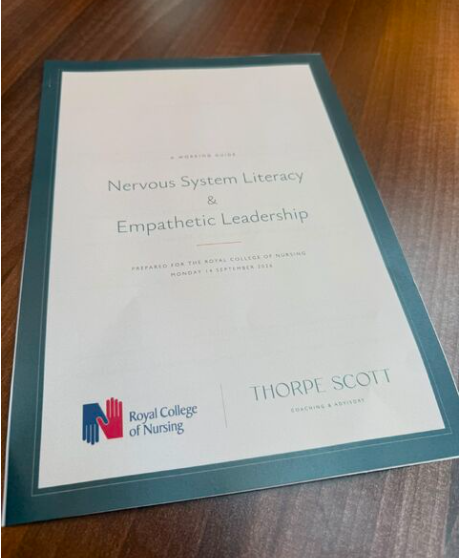
Back in September, I spent the afternoon exploring exactly this with a 50-person executive and senior leadership team at the Royal College of Nursing - Company. Most people in the room know the biology well. Knowing it and noticing it in yourself mid-meeting are two very different skills.
Thank you to the RCN team, and especially to Isabella Heath for extending the invitation.
If you recognise this in yourself or your team, it's worth addressing now, before it shows up in the results. I work with leadership teams in companies and family enterprises.
Email me and let's talk about what it could look like for yours. to me.